Christopher Corso
born 1969 Bamberg
Christopher Corso studied in Munich, attending the Academy of Graphic Design from 1987 to 1991 and the Academy of Fine Arts from 1993 to 1999. He rounded out his education with periods of study abroad in Italy and at the San Francisco Academy of Art in the USA. Today, Christopher Corso is an artist with a unique and fascinating perspective on the modern world.
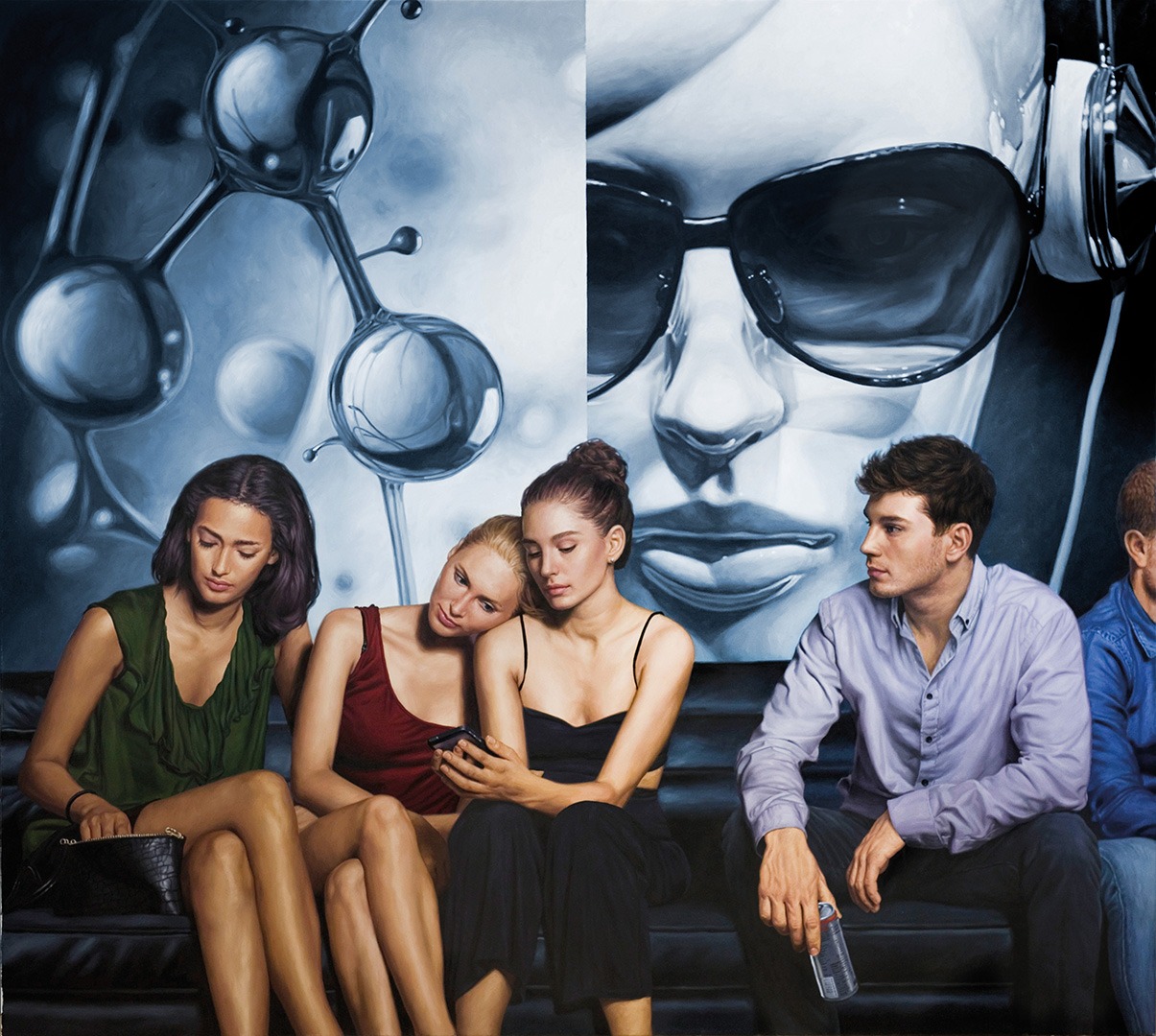
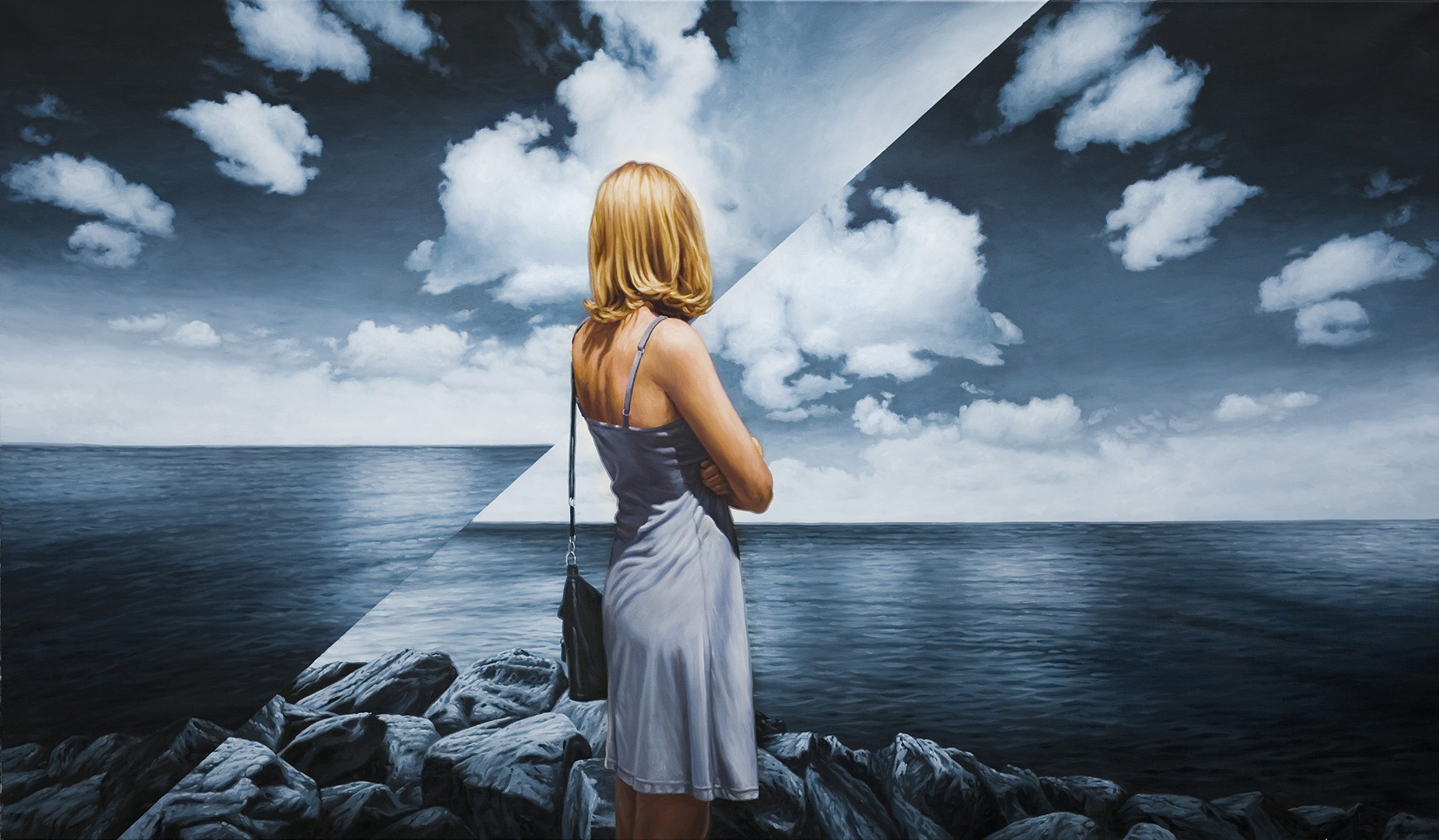
“His painting is a profound engagement with the visual structure of our present—a mirror of the urban experience in the age defined by media fragmentation. His works exist at the intersection of documentary perception and painterly composition: what initially appears to be a kaleidoscopic arrangement of disparate visual elements reveals itself, upon closer inspection, as a layered reflection on the social, psychological, and aesthetic tensions of the digital age.
Corso’s large-format oil paintings are not mere representations, but complex visual essays. In superimposed layers, impressions drawn from advertising, pop culture, urban architecture, and everyday observation are condensed into pictorial spaces where reality and projection become indistinguishable. From the endless flood of visual stimuli, he isolates fragments that—detached from their original context—are transposed into a new and highly artificial constructed visual order. The compositions resist linear narration; instead weaving fragments of reality into open-ended visual narratives that challenge, disorient, and invite introspective reflection.
What makes Corso´s work especially compelling is its ability to not only address themes such as identity dissolution, critiques of consumerism, or the overwhelm caused by constant sensory overload—they stage these phenomena at the level of form. The painted surface serves as both the vehicle for and a symptom of the societal complexity it explores. Through the simultaneity of order and chaos, emotion and detachment, Corso´s work articulate a precise aesthetic of the ‘in-between.’
With his oeuvre, Christopher Corso positions himself not merely as a chronicler of a visually saturated world, but as a perceptive analyst of a collective psychological state. His pictorial spaces are spaces of thought – realms in which the contradictions and anxieties of the twenty-first century are rendered visible, condensed, fractured, and always, at their core, profoundly human.” Prof. Dr. Thomas Knieper
What makes Corso´s work especially compelling is its ability to not only address themes such as identity dissolution, critiques of consumerism, or the overwhelm caused by constant sensory overload—they stage these phenomena at the level of form. The painted surface serves as both the vehicle for and a symptom of the societal complexity it explores. Through the simultaneity of order and chaos, emotion and detachment, Corso´s work articulate a precise aesthetic of the ‘in-between.’
With his oeuvre, Christopher Corso positions himself not merely as a chronicler of a visually saturated world, but as a perceptive analyst of a collective psychological state. His pictorial spaces are spaces of thought – realms in which the contradictions and anxieties of the twenty-first century are rendered visible, condensed, fractured, and always, at their core, profoundly human.” Prof. Dr. Thomas Knieper